
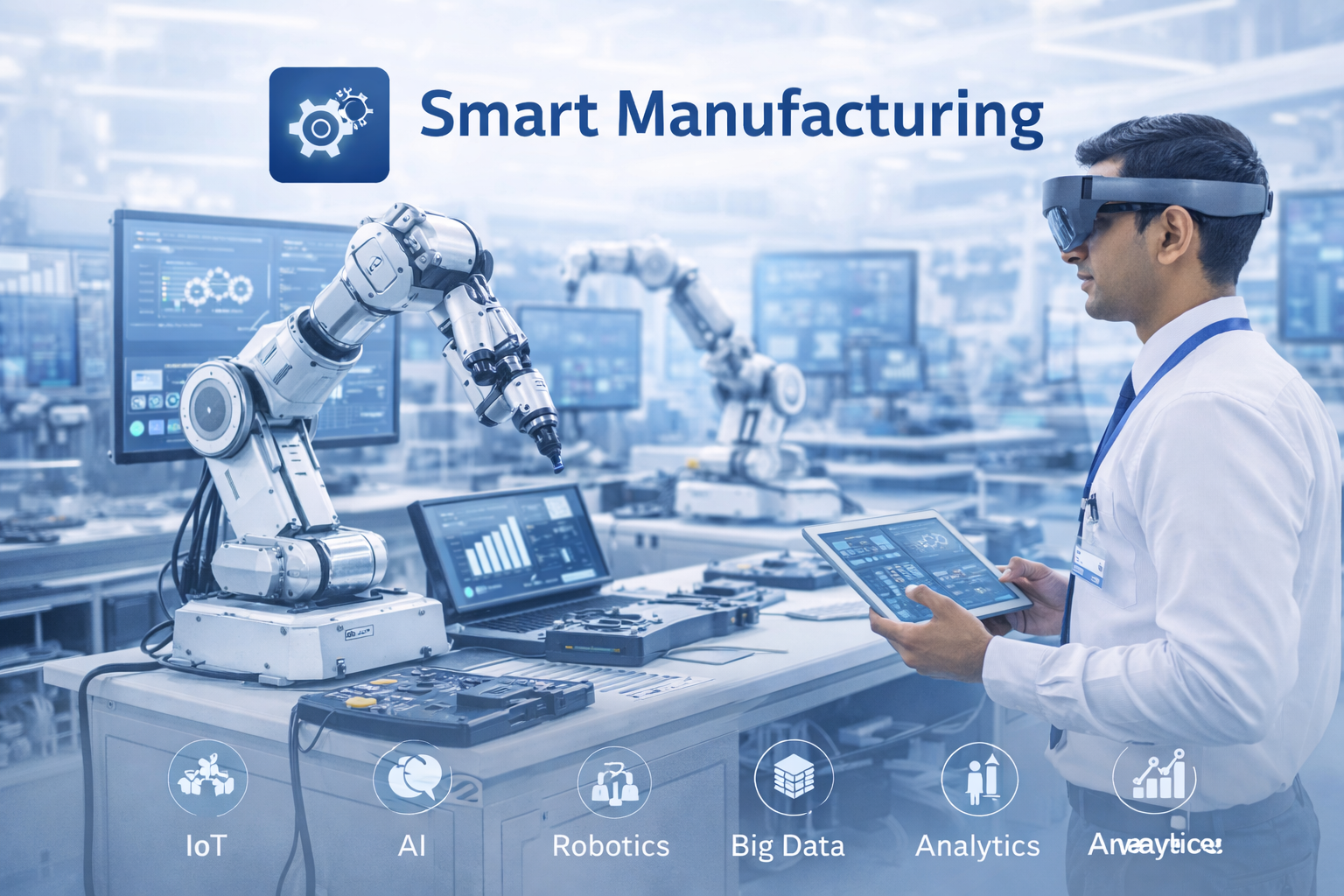
Smart Manufacturing
Smart Manufacturing is an advanced approach to production that leverages cutting-edge technologies such as Artificial Intelligence (AI), Industrial Robotics, Internet of Things (IoT), Big Data, and Automation to create highly efficient, connected, and intelligent manufacturing systems. It represents the core of Industry 4.0, where machines, systems, and humans work together in a digitally integrated environment.
Artificial Intelligence (AI): Enables predictive analytics and smart decision-making.
Industrial IoT (IIoT): Connects machines and devices for real-time communication.
Robotics & Automation: Automates repetitive and high-precision tasks.
Robotics & Automation: Automates repetitive and high-precision tasks.
Cloud Computing: Enables remote monitoring and scalable operations.
In a smart manufacturing setup, machines are interconnected through sensors and software platforms, enabling real-time monitoring, predictive maintenance, and data-driven decision-making. This reduces downtime, improves product quality, and enhances overall operational efficiency.
Unlike traditional manufacturing, smart factories are self-optimizing and adaptive, capable of responding to changes in demand, supply chain disruptions, and production requirements automatically. These systems ensure faster production cycles while maintaining high precision and consistency.
Why Smart Manufacturing Matters
Smart Manufacturing is transforming traditional industries into intelligent, agile, and future-ready ecosystems. It empowers organizations to stay competitive in a rapidly evolving global market by enabling innovation, efficiency, and sustainability.In a smart manufacturing setup, machines are interconnected through sensors and software platforms, enabling real-time monitoring, predictive maintenance, and data-driven decision-making. This reduces downtime, improves product quality, and enhances overall operational efficiency. In a smart manufacturing setup, machines are interconnected through sensors and software platforms, enabling real-time monitoring, predictive maintenance, and data-driven decision-making. This reduces downtime, improves product quality, and enhances overall operational efficiency. Unlike traditional manufacturing, smart factories are self-optimizing and adaptive, capable of responding to changes in demand, supply chain disruptions, and production requirements automatically. These systems ensure faster production cycles while maintaining high precision and consistency. Unlike traditional manufacturing, smart factories are self-optimizing and adaptive, capable of responding to changes in demand, supply chain disruptions, and production requirements automatically. These systems ensure faster production cycles while maintaining high precision and consistency.